
A neutral, category-first comparison — not every workload wants video RAG.
Video RAG vs. Text RAG: What Actually Changes
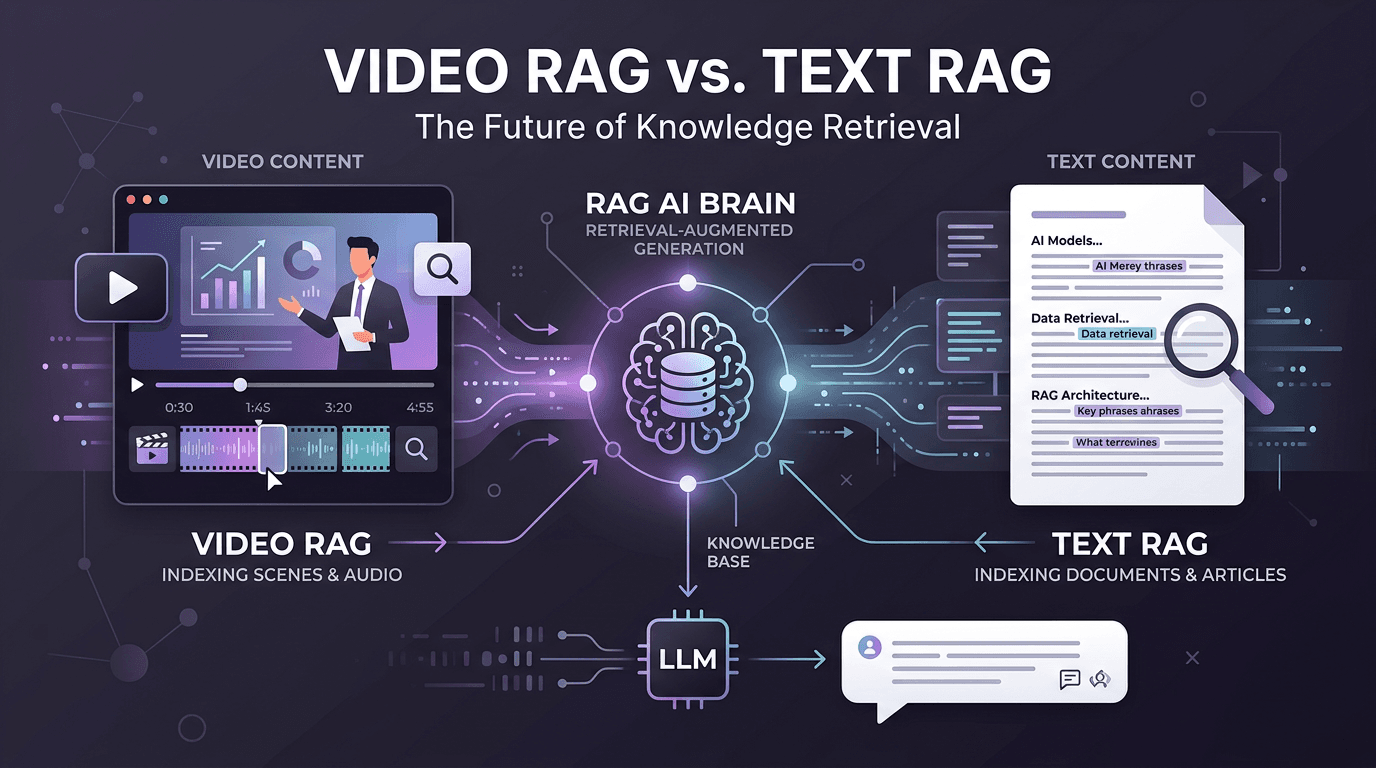
What is video RAG?
Video RAG is retrieval-augmented generation where the knowledge source is a corpus of spoken video content — YouTube channels, internal meetings, recorded lectures, podcasts, customer calls — rather than written documents. The retrieval pipeline is structurally the same as text RAG, but three invariants change: every chunk carries a start/end timestamp, every answer is expected to cite those timestamps, and the ingestion layer has to handle the variety of video platforms and caption states.
The pipeline is the same — until you look at invariants
Text RAG                         Video RAG

Docs / PDFs / tickets            Video URLs / uploads
        │                                │
        ▼                                ▼
┌──────────────────┐           ┌──────────────────────────┐
│  Parse / OCR     │           │  Transcript API          │
│  → text chunks   │           │  → [{start,end,text}]    │
└──────────────────┘           └──────────────────────────┘
        │                                │
        ▼                                ▼
┌──────────────────┐           ┌──────────────────────────┐
│ Chunk (300-600t) │           │ Chunk (300-600t) +        │
│ overlap ~50      │           │ {video_id,start,end,spkr} │
└──────────────────┘           └──────────────────────────┘
        │                                │
        ▼                                ▼
┌──────────────────┐           ┌──────────────────────────┐
│ Embed + index    │           │ Embed + index (hybrid)   │
│ (vector ± BM25)  │           │ (dense + BM25 preferred) │
└──────────────────┘           └──────────────────────────┘
        │                                │
        ▼                                ▼
┌──────────────────┐           ┌──────────────────────────┐
│ Retrieve top-k   │           │ Retrieve top-k + rerank  │
└──────────────────┘           └──────────────────────────┘
        │                                │
        ▼                                ▼
┌──────────────────┐           ┌──────────────────────────┐
│ Generate +       │           │ Generate +               │
│ cite [doc:page]  │           │ cite [video_id:start_sec]│
└──────────────────┘           └──────────────────────────┘
The shape is identical. The invariants are not. Let us walk each stage and call out the video-specific constraint.
Ingestion — the real difference
For text RAG, ingestion is trivial: the document is already text. For video RAG, ingestion owns the whole delta. You need a transcript source that preserves start and end on every segment. You have two production-grade paths:
- DIY: use the official platform APIs for caption retrieval and a speech-to-text provider of your choice for uncaptioned content. You own glue, retries, rate-limit handling, deduplication, and cost accounting across providers.
- Managed: send a video URL to a Universal Transcript Retrieval API and get back a timestamped JSON array. You trade a line item on your P&L for all of the glue above.
For the ingestion side of a production pipeline, see the bulk YouTube transcript guide and the buyer's guide at Best video transcription API in 2026. Once you have segments, the rest of the pipeline is close to standard text RAG.
Chunking — keep timestamps; everything else is similar
Both text RAG and video RAG converge on 300–600 tokens per chunk with ~50 token overlap and semantic boundaries. In video RAG the chunk metadata carries {video_id, start_sec, end_sec, speaker?} instead of {doc_id, page, section}. That single metadata swap is what powers all the downstream differences — grounding format, deep-link UI, eval harness.
One small practical note: YouTube caption segments are often 2–4 seconds of spoken content each, so a 500-token chunk typically spans 60–120 seconds of video. If you are building deep-link UX, that is a comfortable default.
Retrieval — hybrid becomes more important
Dense retrieval works on both transcripts and prose. The asymmetry: spoken language has more filler, false starts, and disfluency, which smear cosine similarity. BM25 on top of a dense index catches the rare technical terms and proper nouns that the embedder blurs. Hybrid retrieval (dense + BM25, fused with reciprocal rank fusion) outperforms dense-only on transcripts by a wider margin than on well-edited prose.
Then rerank. On both text and video RAG, a cross-encoder rerank on the top 15–20 candidates is the single highest-ROI lever in the pipeline. For video RAG specifically, a reranker that understands timestamped context is not yet available off-the-shelf — a standard text cross-encoder on the chunk text is the current best practice.
Grounding — the citation format is not a cosmetic choice
Text RAG commonly cites [doc_id:section] or [doc_id:page]. Video RAG cites [video_id:start_sec]. That is the grounding primitive. Your answer UI parses the citation, resolves it to a URL (e.g. /watch?v=abc123&t=472s), and renders it as a clickable deep-link. Any answer without at least one citation should be flagged — that is your production guardrail against hallucination.
Evaluation — easier on video, not harder
Counter-intuitive: video RAG is usually easier to evaluate than text RAG, because the ground-truth unit is a time range rather than a character offset. Build a golden set of 50–200 query / expected-timestamp pairs. On every change (new chunker, new embedder, new reranker, new prompt) compute:
- Retrieval@k — did the correct ~30-second window make it into the top-5?
- Citation accuracy — when the LLM cites a timestamp, does that segment actually support the claim?
Both are cheaper to run on video than on text: a human verifying a 30-second clip takes less cognitive load than verifying a 500-word passage. That is one of the quietly underrated advantages of video RAG.
Decision matrix — workload to recommended approach
There is no universal winner. The source of truth determines the approach. A rough decision matrix:
| Workload | Video RAG | Text RAG | Picks |
|---|---|---|---|
| Internal meeting Q&A (Zoom / Meet recordings) | Answers jump to the exact moment a decision was made | Works but loses verifiability — users cannot re-hear the claim | Video RAG |
| Engineering docs / runbooks / API docs | Overkill — no audio track to begin with | Native fit; text RAG has a decade of tooling | Text RAG |
| Podcast / lecture / interview search | Per-moment citations replace skipping through a 2-hour episode | Only works on hand-curated transcripts; misses the UX of deep-links | Video RAG |
| Product knowledge base (help center articles) | Only helps if your support content is on video | Built for this; embeddings on articles + BM25 suffice | Text RAG |
| Customer-call compliance review | Timestamped citations are evidentiary-grade for audits | Loses the ability to replay the actual moment — not acceptable for compliance | Video RAG |
| Research paper / PDF search | Not applicable — no spoken content | Clear winner; page and paragraph anchors are the native grounding primitive | Text RAG |
| Creator channel Q&A over a YouTube back-catalog | The entire catalog becomes one searchable corpus with deep-links | Requires manual transcription pipeline to even get text in | Video RAG |
| Internal wiki / Confluence / Notion search | Wrong modality; content is not spoken | Native; works out of the box | Text RAG |
| Video course / MOOC learner assistant | Timestamp deep-links are a killer UX (“jump to 14:22 where the instructor proves it”) | Weak — learners want to hear the explanation, not just read it | Video RAG |
| Mixed corpus (docs + recorded calls + videos) | Ingest everything into one index with source-type metadata | Works but loses the ability to deep-link into audio sources | Either / hybrid |
Mixed corpus — one index or two?
Most production teams end up with a mix: docs, tickets, and videos. The pragmatic answer in 2026 is one index, one embedder, source-type metadata. Treat every chunk as text-plus-metadata. For text sources, the metadata is {doc_id, section, page}; for video sources it is {video_id, start_sec, end_sec, speaker?}. The answer renderer branches on source_type to produce the correct deep-link format. Your retrieval quality improves because the corpus is larger, and your UX is unified.
The alternative — separate indexes per modality — is sometimes useful when access control differs (e.g. docs are company-public, meeting recordings are confidential). In that case, keep the chunk schema identical so you can merge indexes later.
Recap
- The pipeline shape is identical. The invariants differ.
- Timestamps on every chunk; citations in the form
[video_id:start_sec]. - Hybrid retrieval matters more for transcripts than for prose.
- Video RAG wins when the source of truth is spoken; text RAG wins when it is written.
- Mixed corpus: one index, one embedder, source-type metadata.
- Evaluation is easier on video — ground truth is a time range, not a character offset.
For the architecture deep-dive on the video side, see RAG for video transcripts. For the ingestion side, start with the Universal Transcript Retrieval API or the bulk YouTube transcript guide.
Frequently asked questions
Related
All VidNavigator solutions
- Universal Transcript Retrieval API
- YouTube Transcript API
- TikTok Transcription API
- TikTok Profile Scraper API
- TikTok Search API
- Instagram Transcription API
- Facebook Transcription API
- AI Video Search Engine
- Video Analysis API
- Video Data Extraction API
- YouTube Channel Search
- YouTube Channel Strategy
- Tweet Claim Analysis
- X (Twitter) Video Proof