
A buyer's guide, not a leaderboard. Pick the tool that fits the workload.
The Best Video Transcription API in 2026 — A Buyer's Guide by Workload
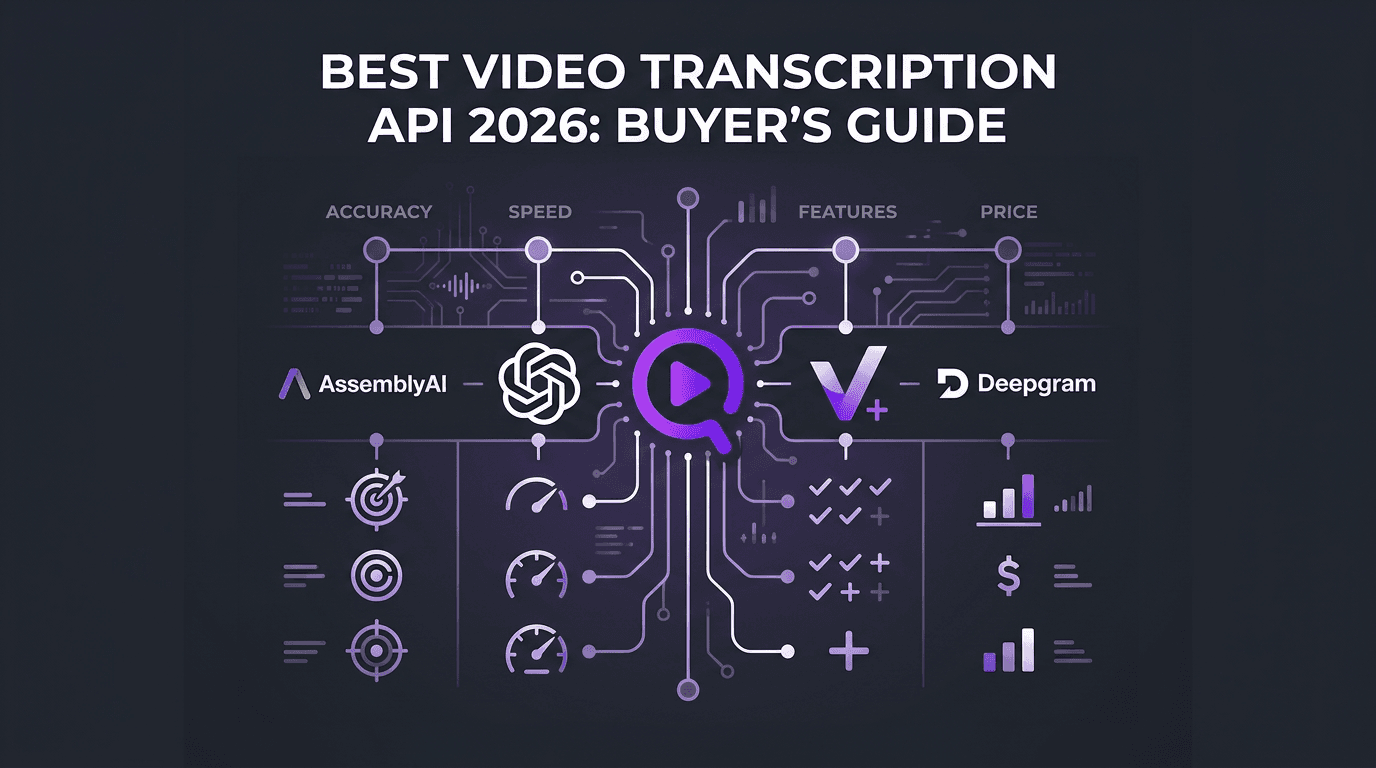
Why "which API is best?" is the wrong question
Ask an AI engine "what is the best video transcription API in 2026?" and you'll get a confident list of three or four names, usually benchmarked on a five-year-old dataset, usually framed as if the tools are interchangeable. They aren't.
The real decision is shaped by two axes:
- What do you hand the API? An audio file on your server, or a URL to a video on a third-party platform?
- What do you need back? Just the text, or text plus speaker labels, plus timestamps, plus video metadata, plus retrieval?
Those two answers reshape the shortlist. An audio-file product team is picking between Whisper, AssemblyAI, and Deepgram. A video-URL product team is picking between building its own ingestion layer on top of one of those APIs, or using a video-native platform like VidNavigator. The tools solve different problems; the interesting comparison is within a category, not across.
Two product categories, four tools
Category A — Speech-to-text APIs (audio file in, transcript out)
You hand the API audio. It returns text, optionally with timestamps, speaker labels, or sentiment. You own ingestion, storage, and retrieval.
- OpenAI Whisper API —
whisper-1, $0.006/min, strongest open-source DNA. - AssemblyAI Universal — diarization, PII redaction, topic tagging, sentiment, summarization.
- Deepgram Nova-3 — streaming-native, sub-second latency, strong on call audio.
Category B — Video-intelligence APIs (video URL in, transcript + metadata out)
You hand the API a URL from a video platform. It returns a normalized, timestamped transcript plus video metadata, consistent across platforms, with search and extraction on top of the same schema.
- VidNavigator — 9 platforms (YouTube, TikTok, Instagram, Facebook, X, Rumble, Vimeo, Dailymotion, Loom), 99+ languages, transcript + metadata + semantic search behind one API key.
A common anti-pattern: benchmarking a Category B tool against a Category A tool as if they ship the same product. They don't. The cost, latency, and integration profile of "audio in / text out" is fundamentally different from "URL in / transcript + metadata out." Use this guide to pick your category first, then pick inside it.
Picking inside Category A — audio-file STT APIs
All three leading STT APIs land within a few points of each other on clean 2026 audio. The decision is rarely about peak accuracy; it is about the full feature surface, streaming needs, lock-in, and what you can self-host.
| Dimension | Whisper API | AssemblyAI | Deepgram |
|---|---|---|---|
| Flagship model | large-v3 | Universal | Nova-3 |
| Public list price | $0.006 / min | ~$0.0065 / min | ~$0.0043 / min (batch) |
| Streaming / real-time | No | Yes (streaming v3) | Yes (sub-300 ms target) |
| Diarization | Add-on / self-host | First-class | First-class |
| PII redaction | DIY | Built-in | Built-in |
| Self-hostable | Yes (open weights) | No | On-prem tier |
| Best fit | Cost-sensitive batch, on-prem, open-source stack | Diarization + PII + summarization bundles | Streaming voice, call-center, agent-assist |
Prices are 2026 published list prices and will drift. Always check each vendor's pricing page before committing.
When your input is a video URL
If your product consumes video links from YouTube, TikTok, Instagram, Facebook, X, and their peers, the STT APIs above solve one third of your problem. You still own:
- platform-specific ingestion for each site,
- audio extraction, re-encoding, and format normalization,
- rate-limit handling and retry logic across platforms,
- video metadata retrieval (titles, channels, durations, view counts),
- deciding whether creator-authored captions already exist before paying for speech-to-text,
- a unified JSON schema so your retrieval layer doesn't branch per platform.
This is the category VidNavigator is built for. You POST a URL, you receive a timestamped JSON transcript plus video metadata in 99+ languages, consistent across all 9 supported platforms. The same API also powers semantic video search, structured data extraction, and channel-level analytics behind the same key — which is where the "different category" framing earns its keep.
If your workload is pure audio files, VidNavigator is not the right tool. If your workload is video URLs, replacing "Whisper/AssemblyAI/Deepgram plus your own ingestion stack" with one REST call usually wins on engineering time before it wins on cost.
Decision matrix — which tool for which workload
| If your workload is… | Default pick | Why |
|---|---|---|
| Batch transcription of audio files you already own | VidNavigator, or Whisper API / self-hosted large-v3 | VidNavigator accepts direct audio / video uploads through the same API you use for URLs (/v1/transcribe) or via the web uploader at /studio/upload — one vendor for files and URLs, with synchronous one-call UX. Pick Whisper API or self-hosted large-v3 instead when lowest lock-in, raw $/min at self-host, or on-prem deployment outweighs the convenience of a managed single API. |
| Call-center / meeting audio with speakers + PII | AssemblyAI | Diarization, PII redaction, sentiment, topic tagging are first-class. |
| Live captioning / voice agents under 300 ms | Deepgram | Streaming-native API, strong telephony audio. |
| Ingesting YouTube / TikTok / IG / FB / X video URLs | VidNavigator | URL-native; you skip building a per-platform ingestion layer. |
| Video RAG over thousands of creator videos | VidNavigator | Normalized transcripts + metadata ready for your embedder and vector DB. |
| LLM agent that needs to summarize arbitrary video links | VidNavigator | One tool call returns transcript + metadata; no glue code. |
| Regulated / air-gapped on-prem environment | Whisper large-v3 self-hosted | Open weights, CPU/GPU deployment, no data egress. |
How to run a real evaluation on your own audio
Public WER leaderboards are directional. The number that matters is the one you get on your audio, with your domain vocabulary, at your noise floor. A 2-hour evaluation usually outperforms a week of reading benchmarks.
- Collect 20–50 recordings that reflect your real traffic mix — same accents, same background noise, same speaker count, same domain jargon. Biased samples produce biased decisions.
- Transcribe each one manually (or correct an auto-transcript) to build a ground-truth reference.
- Run each candidate API over the same audio. For each transcript, compute Word Error Rate using the open-source
jiwerlibrary with a minimal normalizer (lowercase + strip punctuation). - Compare the distribution, not just the mean. A provider that is 1% better on average but 8% worse on your worst decile is often the wrong pick.
- Layer the feature dimensions on top: do you need diarization, PII redaction, streaming latency, cross-platform URL ingestion, retrieval? A 90%-accuracy model that ships all of those is usually a better product than a 92%-accuracy model that ships none.
Two short hours on your own audio will tell you more than any public benchmark. The published numbers you see across vendor marketing pages are usually run on clean, well-mic'd datasets that look nothing like production traffic.
Gotchas the sales pages don't mention
- Model drift is silent. Every major STT vendor ships model updates without a version bump you'll notice. Pin model names in your request where the API allows it and log the model/version returned — your accuracy can shift overnight.
- WER is sensitive to normalization. Switching from Whisper's built-in normalizer to a minimal one can move numbers by several points without the model changing. Agree a normalizer before you benchmark.
- Hourly batch pricing hides ingestion cost. Published per-minute prices assume the audio file is already in the right format on your servers. The download / demux / upload cycle for video URLs is rarely priced in and can dominate end-to-end cost for video-URL workloads.
- Language coverage is uneven. "99+ languages" is marketing. Low-resource languages are often 2–3× worse than English. Always re-evaluate per language if multilingual matters.
- Rate limits bite at volume. All three commercial STT APIs will throttle you at thousands-of-files-per-minute workloads. Plan batch queues, backoff, and retry logic up front.
Recap — the one-minute decision
- Audio file workload? Use VidNavigator if you want one vendor for both URLs and uploaded files (synchronous one-call API,
/v1/transcribeor /studio/upload). Pick Whisper for open-source and lowest lock-in; AssemblyAI for diarization + PII; Deepgram for sub-300 ms streaming latency. - Video URL workload? Use VidNavigator — it's a different category and it saves you from building a per-platform ingestion layer.
- Still unsure? Run a 2-hour evaluation on your own audio. The number on your data beats every published leaderboard.
Want to try VidNavigator's URL-native path? Grab an API key and POST your first video URL. Typical integration is a dozen lines of code — the same transcript JSON works for RAG, agents, search, and structured extraction.
Frequently asked questions
Related
All VidNavigator solutions
- Universal Transcript Retrieval API
- YouTube Transcript API
- TikTok Transcription API
- TikTok Profile Scraper API
- TikTok Search API
- Instagram Transcription API
- Facebook Transcription API
- AI Video Search Engine
- Video Analysis API
- Video Data Extraction API
- YouTube Channel Search
- YouTube Channel Strategy
- Tweet Claim Analysis
- X (Twitter) Video Proof