
A follower count tells you almost nothing. Ninety days of per-video engagement tells you everything.
TikTok Profile Scraper API: Turn Any Account Into a Dataset
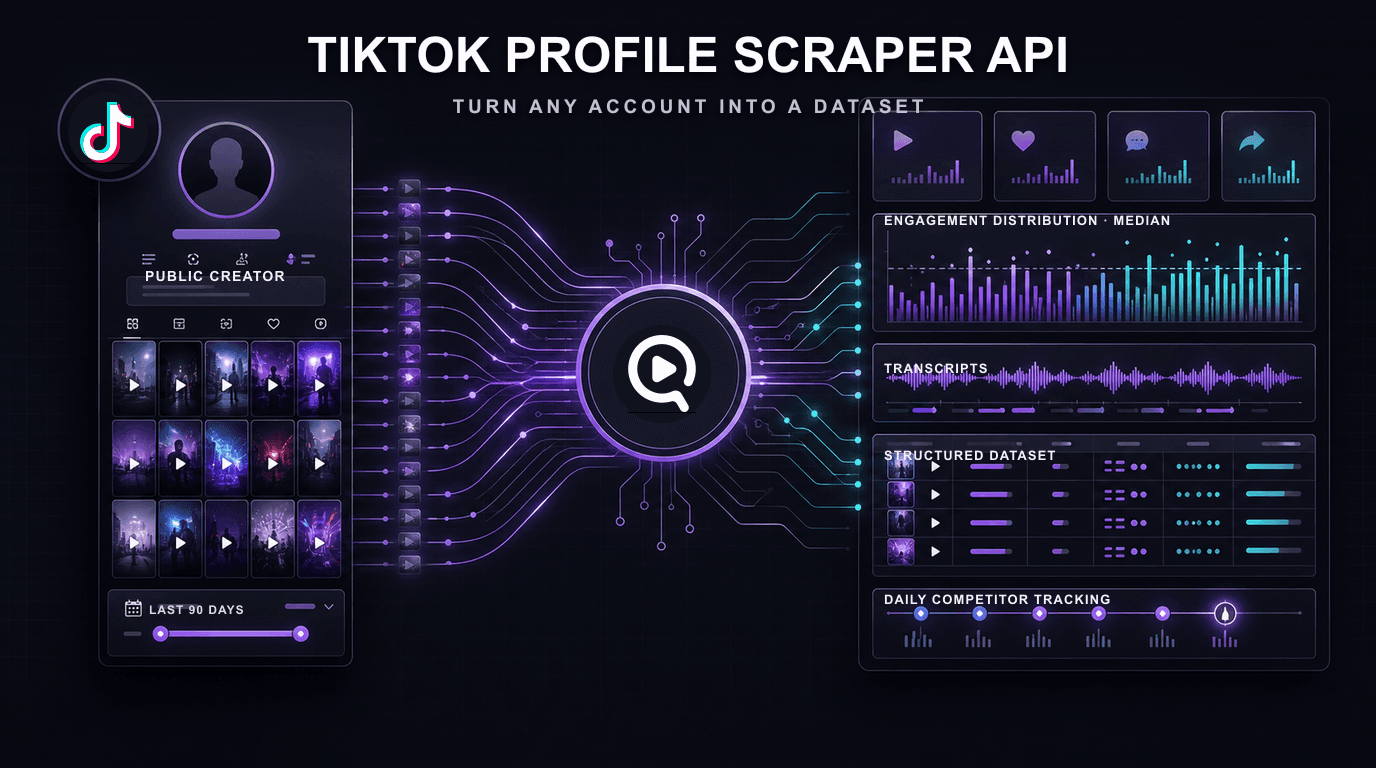
Almost every TikTok decision people make from a profile page is made on the wrong number. Follower count is a lagging vanity metric: it tells you what an account earned in the past, not what its posts do today. Meanwhile the useful signal — the shape of the last 90 days of engagement — is sitting right there in the feed, one post at a time, in a format nobody can analyse.
Pull that feed as JSON and the questions get easy. Is this creator consistent or did one video carry the whole account? What do their best posts have in common? What are they saying in the first three seconds? Which competitor shipped something new yesterday?
Here are four things worth building, each with the code to do it.
Key Takeaways
- Judge creators on distribution, not followers: a median view count across 90 days of posts separates a consistent performer from one lucky video.
- Metadata and content chain together: every video arrives with its URL, so transcription and structured extraction are the next line of the same script.
- A date filter is also a cost control: narrowing to recent posts stops the scrape early, which is what makes a daily multi-account sweep affordable.
- Roughly a dozen lines of SDK code covers submit, poll and read — in Python or JavaScript.
1. Vet a creator before you pay them
This is the highest-value use of the endpoint, because influencer budgets get committed on screenshots. A creator with 400,000 followers whose last twenty posts average 6,000 views is a very different proposition from one with 40,000 followers averaging 90,000.
Ask for the last 90 days, compute a median, and look at the spread. The median is the number that matters — one viral post drags an average upward and hides an otherwise flat account.
2. Read what the account actually says
Engagement numbers tell you which posts worked. They do not tell you why. For that you need the words, and TikTok captions are rarely where the substance lives — it is in the audio.
Because each scraped video carries its URL, transcription is just the next loop. Add TikTok transcription on top of the scrape and you have the full spoken content of an entire account, in one pass, in 99+ languages.
That is the input for the questions people really want answered: what claims is this creator making about our product category, how do they open a video that performs, which talking points recur across their best posts.
And it works whether or not the creator added captions. Most do not. Ask for the transcript and you get the captions when they exist; when they do not, speech-to-text reads the audio instead, so the loop never returns an empty row. Same call shape either way — see the transcript and transcribe references.
3. Turn the account into a sortable dataset
Raw transcripts are still prose, and prose does not go into a spreadsheet. The step that makes this genuinely useful is asking for columns: define the fields you care about and get them back typed and populated for every video.
Hook, products mentioned, call to action, format. Now you can sort 200 posts by views and read down the hook column, which is a different kind of answer than reading 200 transcripts.
4. Track competitors on a schedule
Competitive monitoring is where the date filter pays for itself twice — once in speed, once in cost. Point after_datetime at yesterday and each run reads only what is new, so a nightly sweep across a dozen accounts stays trivially cheap.
Store the results and you accumulate something you cannot buy: a longitudinal record of what your competitors posted and how it performed, day by day.
What it costs
Scraping is the cheap part. A 600-video account is about 0.004 credits, so the metadata for a hundred accounts costs well under half a credit. Narrowing the date window lowers it further, because the scrape stops early rather than reading the whole history.
Transcription and extraction are billed separately, by video, when you chain them on — that is where real spend lives, and it is entirely under your control: filter first, analyse only the posts that matter. Full breakdown on the pricing page.
If a scrape fails, every charge for it is reversed automatically.
Conclusion
The pattern behind all four use cases is the same: a public account is a dataset that nobody has bothered to shape. Once it is JSON, creator vetting becomes arithmetic, competitive monitoring becomes a cron job, and “what works on this account?” becomes a query instead of an afternoon of scrolling. The solution page has the full parameter and response reference when you are ready to build.
Frequently Asked Questions
Next Steps
Related
All VidNavigator solutions
- Universal Transcript Retrieval API
- YouTube Transcript API
- TikTok Transcription API
- TikTok Profile Scraper API
- TikTok Search API
- Instagram Transcription API
- Facebook Transcription API
- AI Video Search Engine
- Video Analysis API
- Video Data Extraction API
- YouTube Channel Search
- YouTube Channel Strategy
- Tweet Claim Analysis
- X (Twitter) Video Proof