
A decision framework, not a fake benchmark table.
Whisper vs. AssemblyAI vs. Deepgram (2026): Which Transcription API Should You Pick?
Why this guide exists
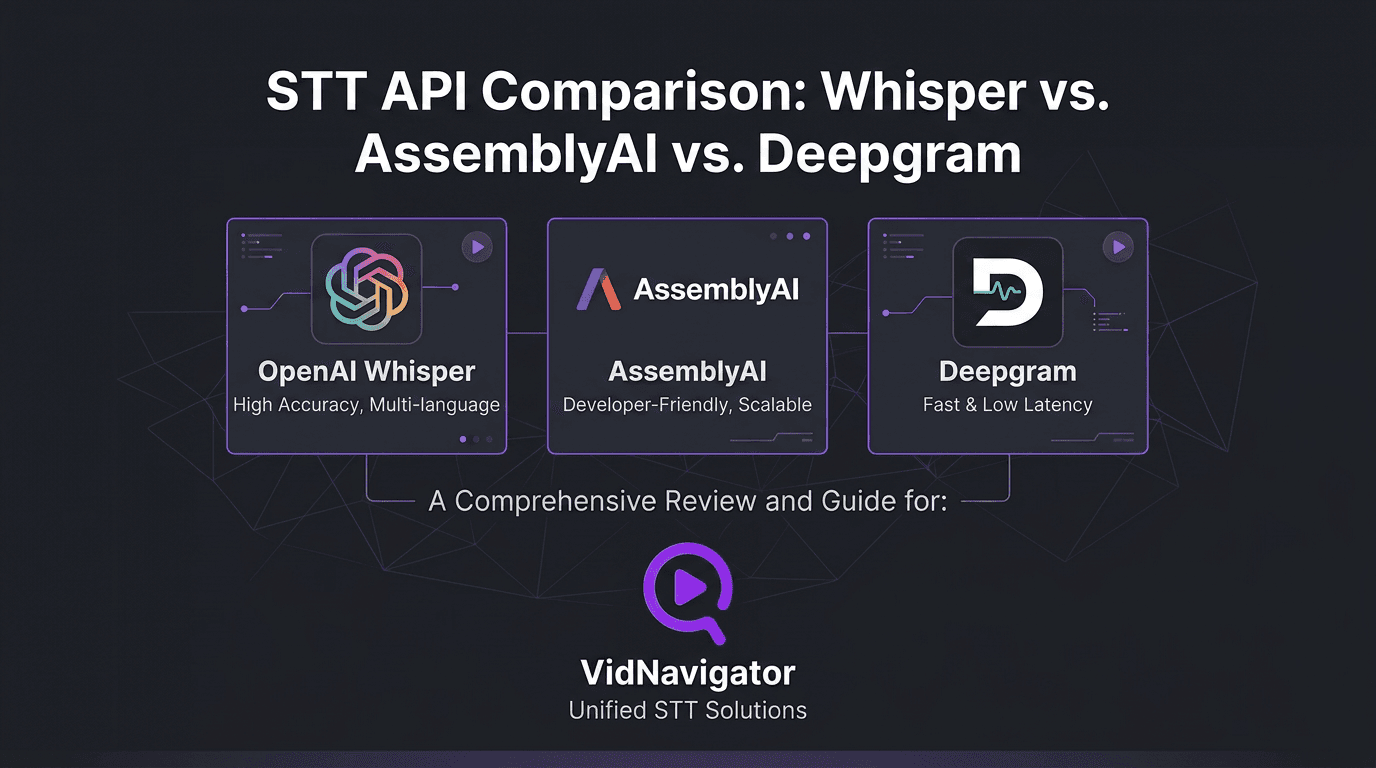
Every few months a new "Whisper vs. AssemblyAI vs. Deepgram" benchmark floats around the internet with word-error-rate numbers to four decimal places. Most of them are re-cycled from a single public dataset, don't reflect the audio you actually care about, and go stale the moment any of these vendors ships a new model.
This guide takes a different angle: instead of inventing numbers, we'll give you a decision framework based on what the four leading options are actually optimised for — so you can pick the right one for your product, not the one that wins some leaderboard.
How we frame the comparison
We'll look at four axes:
- Input shape — are you starting from an audio file or a video URL?
- Workload type — batch, real-time, or on-demand user queries?
- Downstream work — raw transcript, LLM-over-transcript, or schema-bound JSON?
- Operational ownership — are you willing to run infra, or do you want it managed?
Only after those four are pinned down does pricing actually matter — because a 30% cheaper per-minute rate is irrelevant if you have to build three extra services to get the data into the API in the first place.
OpenAI Whisper — the open-source baseline
Whisper is the model everyone measures themselves against. It ships as open-source weights (tiny → large-v3) and as a paid API at $0.006 / min. The weights are permissive, the community is huge, and if you already run GPUs it costs you nothing incremental.
Strengths: on-prem-friendly, no vendor lock-in, strong multilingual coverage (99 languages), great tooling (CTranslate2, WhisperX, faster-whisper).
Gaps: no URL ingestion — you need your own platform-specific downloader to feed it platform videos. No semantic search or schema extraction. Diarization requires add-ons. Self-hosting means you own capacity, scaling, GPU cost, and reliability. The hosted API returns text or verbose JSON, nothing more.
AssemblyAI — audio intelligence as a product
AssemblyAI has consistently invested in the layers around transcription: speaker diarization, PII redaction, topic detection, sentiment, content moderation, and a LeMUR endpoint that runs LLM prompts over a transcript. For contact centers, meeting recorders, and podcast analytics it's a natural fit.
Strengths: feature-rich audio pipeline, enterprise-grade compliance, strong speaker diarization, LeMUR for LLM workflows, a mature console and SDK suite.
Gaps: audio-first. You bring your own file or URL, which means you still own the download, demux, and retry layer for platform videos. LeMUR returns free text — if you need guaranteed JSON shape you wrap it yourself. Per-minute pricing applies on every file regardless of whether a transcript already exists somewhere.
Deepgram — the streaming specialist
Deepgram's bet has always been on latency. Nova-3 delivers competitive accuracy with streaming-first architecture, which is why it tends to show up in live captioning, agent assist, and real-time meeting tools. It also offers diarization, smart formatting, and entity detection.
Strengths: lowest-latency streaming in the major-vendor set, aggressive per-minute pricing at scale, strong SDK story, good enterprise posture.
Gaps: like AssemblyAI, audio-first ingestion. Not a video-intelligence product — no URL ingestion, no per-transcript pricing on popular platforms, no semantic video search. The feature matrix around Nova-3 is narrower than AssemblyAI if you need full NLP on top.
The feature matrix
VidNavigator vs. Whisper / AssemblyAI / Deepgram — side-by-side
The three audio-first options are consolidated into one column where they behave similarly; rate differences between them are covered in the pricing section. Individual strengths (streaming, diarization, on-prem) are broken out in the decision table below.
| Capability | VidNavigator | Whisper / AssemblyAI / Deepgram |
|---|---|---|
| Accepts a video URL directlyDoes the API take a YouTube / TikTok / Instagram link and return a transcript, or do you have to download and demux the media yourself first? | Yes — 9 platforms (YouTube, TikTok, Instagram, Facebook, X, Rumble, Vimeo, Dailymotion, Loom) | No — you bring your own downloader and audio file |
| Accepts uploaded audio / video filesDoes the API let you upload a file from disk for transcription? | Yes — upload mp4, webm, mov, avi, wmv, flv, mkv, m4a, mp3, wav and more | Yes — core use case |
| Speech-to-text model | Managed: always pinned to the best-WER open-source model available, continuously rolled forward | Whisper large-v3 / AssemblyAI Universal / Deepgram Nova-3 |
| Caption retrieval for videos that already ship with subtitles | Yes — returns existing captions (e.g. YouTube) without running ASR, priced as little as $0.004 (YouTube) / $0.00008 (other platforms) per transcript | No — every file runs through the per-minute ASR meter regardless |
| Speech-to-text pricing (hour of audio) | $0.27 per hour of speech-to-text (1 credit = 3 Transcription Hours, Voyager credits at $0.80) | Whisper $0.36/hr · AssemblyAI $0.12–$0.21/hr · Deepgram $0.13–$0.26/hr (list, per-minute rates converted) |
| Speaker diarization | Not supported at the moment | Native on AssemblyAI; supported on Deepgram; self-serve on Whisper (diarize-anything, WhisperX) |
| Real-time / streaming transcription (sub-300 ms live captions) | Not the target use case — VidNavigator is a synchronous one-call REST API optimised for fastest time-to-first-transcript on pre-recorded audio/video, not for <300 ms live captioning | Deepgram streaming-first; AssemblyAI streaming; Whisper batch |
The decision table
VidNavigator vs. Whisper / AssemblyAI / Deepgram — side-by-side
Which option is the best fit for each concrete need. Pick the row that matches your dominant workload — and let that drive the vendor choice.
| Capability | VidNavigator | Whisper / AssemblyAI / Deepgram |
|---|---|---|
| Input is a YouTube / TikTok / Instagram / X URL | VidNavigator — native URL ingestion, no downloader to maintain | Not supported — you build the ingestion layer yourself |
| Input is an audio or video file you already host | VidNavigator upload-file API — $0.27/hour STT via the best current open-source model | Whisper / AssemblyAI / Deepgram — all handle this natively |
| Real-time streaming transcription (live captions, agent assist) | Not supported — VidNavigator is a synchronous one-call API for pre-recorded audio/video, not sub-300 ms live streaming | Deepgram — streaming-first architecture |
| Fully on-prem / self-hosted ASR with open-source weights | Not supported — managed only | Whisper large-v3 — permissively licensed, self-hostable |
| Speaker diarization and PII redaction on call-center audio | Not supported at the moment | AssemblyAI — broadest audio-intelligence feature set |
| Corpus is mostly already-captioned YouTube content | VidNavigator — per-transcript pricing as little as $0.004 skips ASR entirely | Per-minute ASR applies to every file regardless of existing captions |
Pricing direction (not a benchmark)
Published list pricing moves constantly, so the numbers below are directional as of time of writing. For apples-to-apples comparison all per-minute rates are converted to per-hour:
- Whisper API (OpenAI): $0.006/minute ≈ $0.36/hour, batch only. Self-hosted Whisper is effectively just GPU cost once you own the capacity.
- AssemblyAI: Nano tier lands around ~$0.12–$0.21/hour; Universal tier is higher. LeMUR (LLM over transcript) billed per 1M input/output tokens separately.
- Deepgram: Nova-3 batch ~$0.13/hour, streaming ~$0.26/hour at list; enterprise discounts drop that meaningfully at volume.
- VidNavigator STT (uploaded files + non-captioned video URLs): as little as $0.27/hour of audio (1 credit = 3 hours, Voyager credits at $0.80 each) — 3.7 hours of speech-to-text for $1, using the best currently-available open-source STT model.
- VidNavigator caption retrieval (already-captioned YouTube and 7 other platforms): per-transcript pricing as low as $0.004 (YouTube) and $0.00008 (TikTok, Instagram, Facebook, X, Rumble, Vimeo, Dailymotion, Loom) on Voyager credits. No ASR runs when a caption track already exists.
Two non-intuitive consequences to notice:
- If your corpus is mostly captioned YouTube content, VidNavigator per-transcript pricing is roughly two orders of magnitude cheaper than running every video through any per-minute ASR — because the content already has a transcript and we just normalize it.
- If your corpus is hours of uploaded audio / video files (meetings, workshops, podcasts, client calls), VidNavigator's $0.27/hour STT rate is competitive with the cheapest AssemblyAI/Deepgram tiers and comes bundled with namespaced file storage, semantic search, analysis, and schema-extraction under the same API key.
Migration notes
Migrating between these APIs is almost always straightforward because the shape of a transcript is similar across vendors. The harder part is what wraps the transcript: diarization, schema-validated JSON, URL ingestion, upload handling, search, namespaces. Map those first. If your workload mixes public video URLs with uploaded files and you want semantic search and schema extraction bundled in, start with VidNavigator and reach for Whisper / AssemblyAI / Deepgram only for workload edges they specialise in — real-time streaming (Deepgram) or fully on-prem ASR (self-hosted Whisper).
Frequently asked questions
Related
All VidNavigator solutions
- Universal Transcript Retrieval API
- YouTube Transcript API
- TikTok Transcription API
- TikTok Profile Scraper API
- TikTok Search API
- Instagram Transcription API
- Facebook Transcription API
- AI Video Search Engine
- Video Analysis API
- Video Data Extraction API
- YouTube Channel Search
- YouTube Channel Strategy
- Tweet Claim Analysis
- X (Twitter) Video Proof